| Feature | HashMap | TreeMap |
|---|
| Implementation | Uses a hash table internally. | Uses a red-black tree internally. |
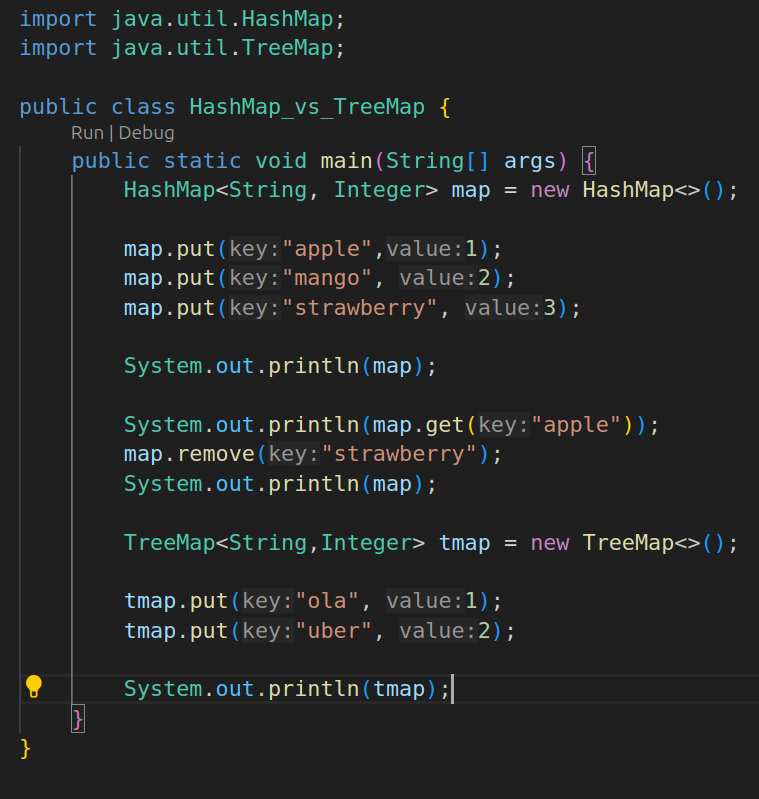
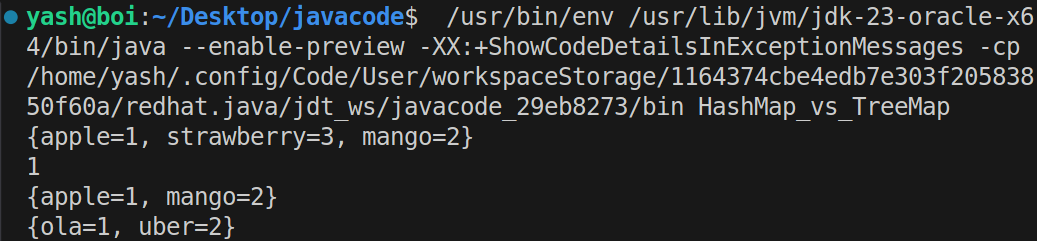
| Ordering | No specific order, elements are stored randomly. | Sorted order (natural or custom comparator). |
| Duplicates | Allows only one null key and multiple null values. | Allows only one null key (null values are allowed). |
| Performance | Faster for most operations (O(1) average for get(), put(), remove()). | Slower (O(log n)) for get(), put(), remove() due to tree traversal. |
| Use Case | When order of elements is not important, and you need fast access. | When you need elements to be sorted (ascending or custom order). |
| Iteration Order | No guaranteed order during iteration. | Iterates in sorted order. |
| Memory Usage | Less memory overhead due to hash table. | More memory due to the tree structure. |
| Methods | Doesn’t provide methods for range queries. | Provides methods like subMap(), headMap(), tailMap() for range queries. |
- HashMap:
- No order guaranteed.
- Faster (
O(1) average for get(), put(), remove()).
- Allows one null key and multiple null values.
- TreeMap:
- Always sorted (ascending or custom order).
- Slower (
O(log n) for get(), put(), remove()).
- Allows one null key but only non-null values.
When to Use Which?
- Use HashMap when you don’t care about the order of elements, and you want fast access to values by keys.
- Use TreeMap when you need elements sorted in ascending order (or custom order using a comparator), and you are okay with slightly slower performance.